List of Validators
In this section, we will see how to find lists of validators. As a delegator, we will see how to choose a validator.
List of validators
The Nexus has a list of validators ordered according to different criteria. This allows delegators to choose their validator in the most comfortable way. Check out the explorer module an in-depth list of block explorers.
Mavryk Nexus allows you to browse through validators.
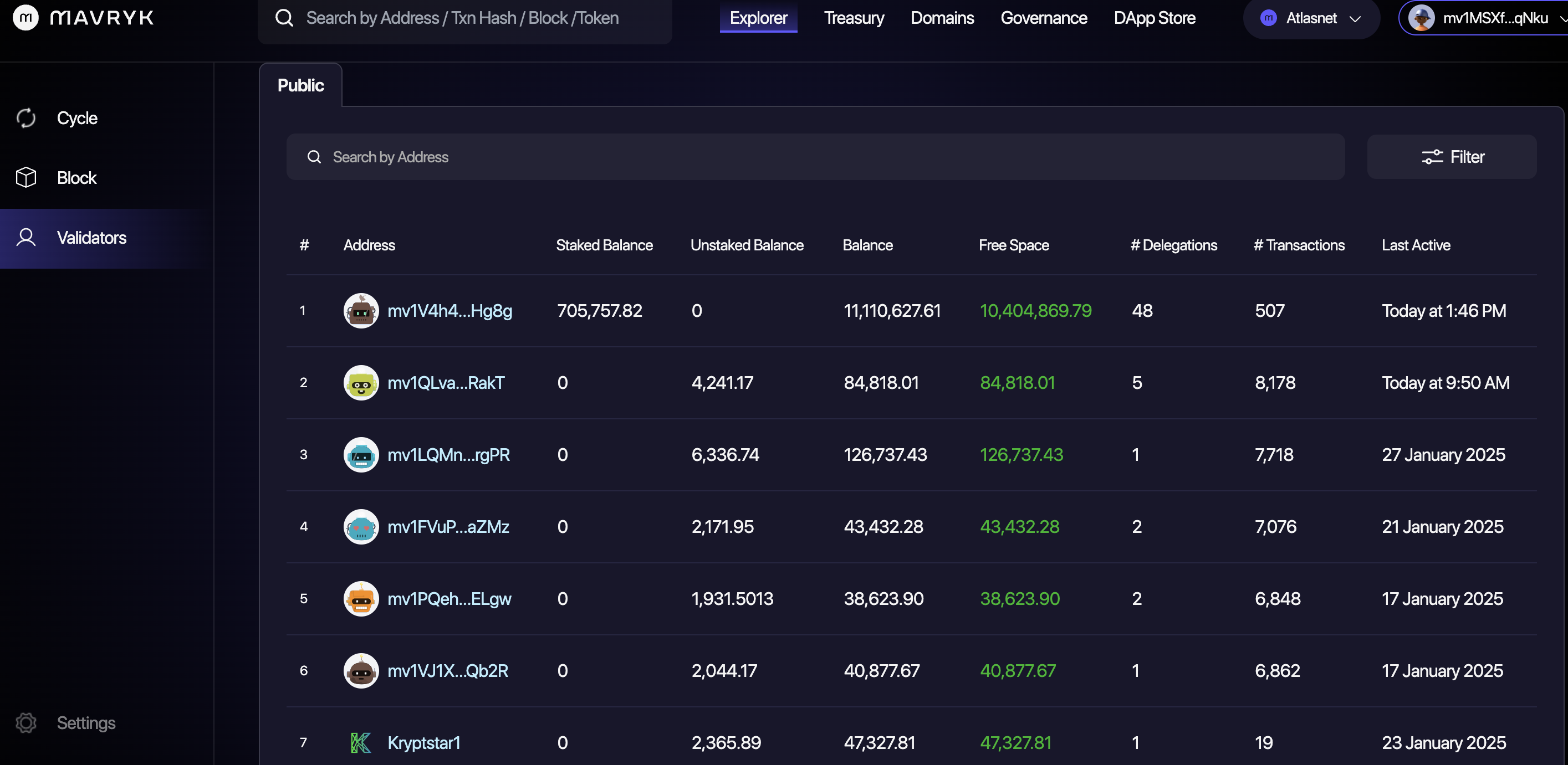
What kind of validator?
You have probably come across terms like public validators, private validators or corporate validators. How are they different? In terms of protocol, i.e. participation in block validation, there is no difference. The actual differences are as follows.
Public validators
A public validator is different from a private one by functioning as a public staking service promising to share its profits with anyone who had delegated them their stakes.
Private validators
A private validator is a validator that doesn’t permit other account to delegate their stakes to it. Technically speaking, they can’t forbid you to delegate your Mav to them, but they are under no obligation to share their validating profits with you.
These days, it is the centralized exchanges like Coinbase, Binance or Kraken, that hold the biggest stakes. They offer their users an opportunity to stake Mav from their exchange accounts and get profits.
Corporate validators
A corporate validator only means that someone wants to emphasize that it is a corporation that validates on Mavryk. Such a validator can be private or public.
How to choose a validator?
Criteria
There are a few factors to consider when choosing a validator to delegate to:
Staking balance
This is the Mavryk validator’s staking balance, which includes his own Mav funds (bonds) and all the delegated funds. In the short term, the greater the stake, the less the validator’s profit fluctuates from cycle to cycle. This happens due to the randomness in the distribution of validating rights in Mavryk, which means the more rolls, the less variance, and the fewer rolls, the more variance.
ROI (Return On Investment)
This is how much Mavryk staking rewards you would earn per year if you delegate to a particular validator, assuming the validator accurately pays all the rewards, doesn’t miss payouts, and doesn’t change the fee and other terms.
Fee
This is how much the Mavryk validator charges from the staking rewards he distributes between his delegators. On average, the profitability is the same across all validators, yet their customers have varying profits as different validators have different fees. If the fee is too high or too low, it’s a good reason to start thinking why.
Free space
This is how much Mav you can delegate to the validator. A negative value indicates that the validator is likely overdelegated, which is very unwanted as he will miss blocks and attestations.
Each time a validator creates/attests a block, they have to lock a certain amount for 5 cycles as a security deposit. Overdelegation is when the available Mav balance is not enough (because the entire balance has already been locked) so, they skip block/attestation.
Minimum delegated amount
Validators can set up a minimum amount they expect to get from a delegator. Some accept stakes starting from 1 Mav while others from 1000 Mav.
Payouts accuracy
This value indicates how accurate the validator’s payouts are.
Payouts periodicity
This value indicates whether the validator pays according to his payment schedule or not.
Conclusion
Those were the things you should check when choosing a validator. It is up to you to decide which criteria are more important than the others. But no matter what, your choice of a validator should be conscious and well reasoned.